
Monitoring
What happens to the trend when a filter restarts?
A restart leaves a time signature. Comparing the turbidity trace with the filter log helps operators work out what the PTV 1000 was measuring as the filter came back online.
Read article

Monitor low-level turbidity continuously with the Lovibond PTV 1000. PMA supports drinking water instrument selection, installation and service in the UK.
Explore PTV 1000A continuous reading helps operators see when a change started and how long it lasted. Pair the trend with filter runs, backwashes and plant events so you can decide where to investigate. Use the same sample point and method when comparing with a grab sample.

See where a continuous turbidity reading can help, from individual filters to treated water and pre-UV monitoring.

Follow turbidity at the outlet of an individual filter and give operators a clearer view of how each filter is performing.

Track low-level turbidity in filtrate alongside the plant’s membrane monitoring programme.

Track changes in turbidity at a final-water, storage or transfer point within a drinking-water system.

Monitor the blended water leaving a bank of drinking water filters and keep the trend tied to the filters that were in service.

Follow the first water after backwash and match the turbidity trend to the outlet route before the filter returns to service.

Follow filtered water entering a UV treatment stage and keep the turbidity trend alongside the reactor’s own operating records.
Work through the take-off, flow and drain before you go to site.

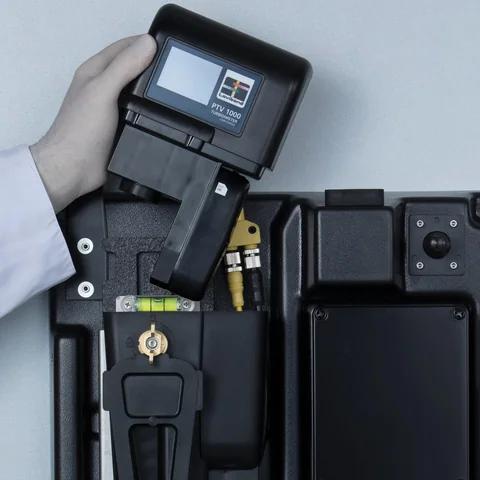
See how the mounting cleat, flow body and fluidics manager fit together.
The infrared model reports in FNU and the white-light model reports in NTU. Match the optical method to the specification first, then plan how the reading and its units will be recorded by the plant.
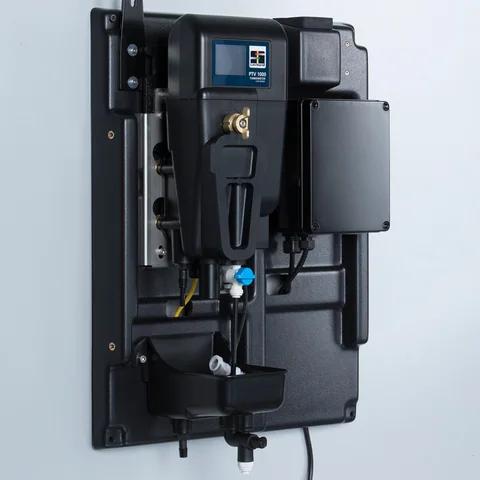
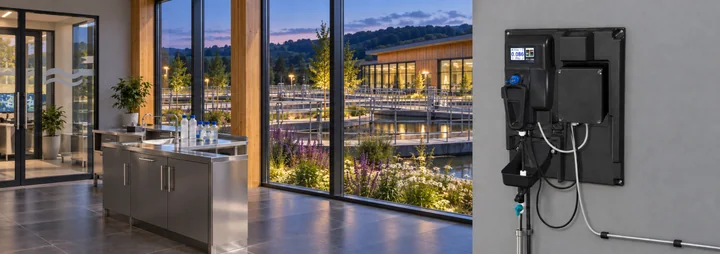
Plan the water path and the signals operators will use to interpret a change.
Review installationFollow the Lovibond video demonstrations for installation and routine care. The AquaLXP section explains what operators can do with a compatible Bluetooth instrument and an iPhone.
Practical articles on interpreting turbidity, choosing an optical method and verifying your instrument.
A restart leaves a time signature. Comparing the turbidity trace with the filter log helps operators work out what the PTV 1000 was measuring as the filter came back online.
Read article
Choosing between the PTV 1000 infrared and white-light models affects the instrument order, the historian and how operators compare new readings with the existing record.
Read article
A useful verification record gives the next technician enough information to repeat the check, explain the result and reconnect it to the plant trend.
Read articleSince 1971, PMA has helped UK water and industrial teams choose and look after process instrumentation. Alongside turbidity analysers, our range includes water quality sensors, analytical reagents and specialist tubing.
It measures turbidity in a flowing water sample by detecting light scattered by particles. It is intended for continuous low-level monitoring in drinking-water applications.
The infrared model uses ISO 7027 and reports in FNU. The white-light model uses the Lovibond white-light LED method and reports in NTU.
Typical points to review include filter outlets, membrane filtrate and treated water. Confirm the sample conditions and measurement objective at each point.
Bubbles can affect an optical reading. The instrument has a bubble trap, and a stable sample arrangement still matters.
Check the exact instrument and junction-box configuration against the signals or protocol your site requires.
Record the sampling point, optical method, expected range, sample flow and pressure, drain location and required plant connection.
Choose where you’ll measure, which optical method applies and how the reading will reach your plant system. Save a brief for discussion with PMA.
Confirm the sample conditions and exact junction box with PMA before specifying an instrument.
Gather the sample, method and plant connection details for a discussion with PMA.
Prepare your enquiryHave the sampling point, expected turbidity and operating flow to hand.