

Lovibond PTV 1000
An online turbidity analyser for continuous low-level measurement in drinking water. Compare the infrared and white-light models and plan your sample route.
Compare optical modelsBuilt for a flowing sample
The PTV 1000 combines an optical sensor head and a flow body with a bubble trap. Install it where you can supply a representative sample and reach the instrument for routine checks. Record the sample route and flow so changes in the installation can be taken into account when interpreting the trend.
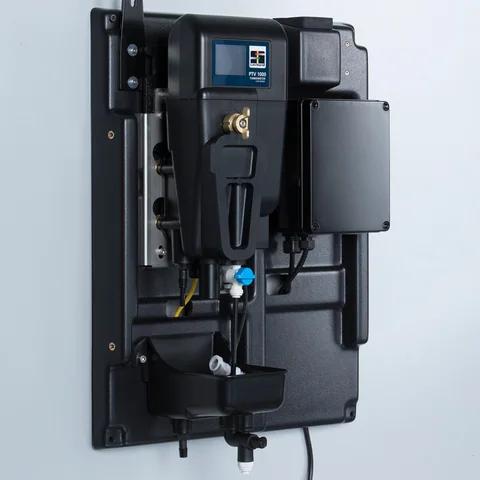
Compare the PTV 1000 models
Choose the optical method your site specifies. Keep the reporting units with the measurement wherever you display or export it.
| Specification | PTV 1000 IR | PTV 1000 WL |
|---|---|---|
| Light source | Infrared | White light |
| Measurement method | ISO 7027 | Lovibond white-light LED method (US EPA) |
| Reporting units | FNU | NTU |
| Measuring range | 0.0001–100 FNU | 0.0001–100 NTU |
| Published accuracy | ±2% of reading up to 10 FNU, ±4% above 10 FNU | ±2% of reading up to 10 NTU, ±4% above 10 NTU |
Build the installation around the sample
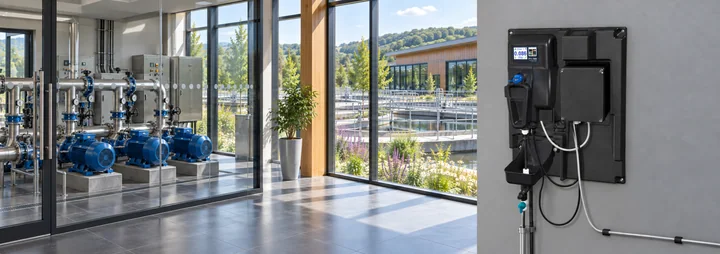
A useful trend starts with a representative take-off, a stable sample and access for routine checks. Confirm the expected turbidity range, temperature and pressure across the operating cycle. Agree the output required by the plant and check that the installed junction box supports it.
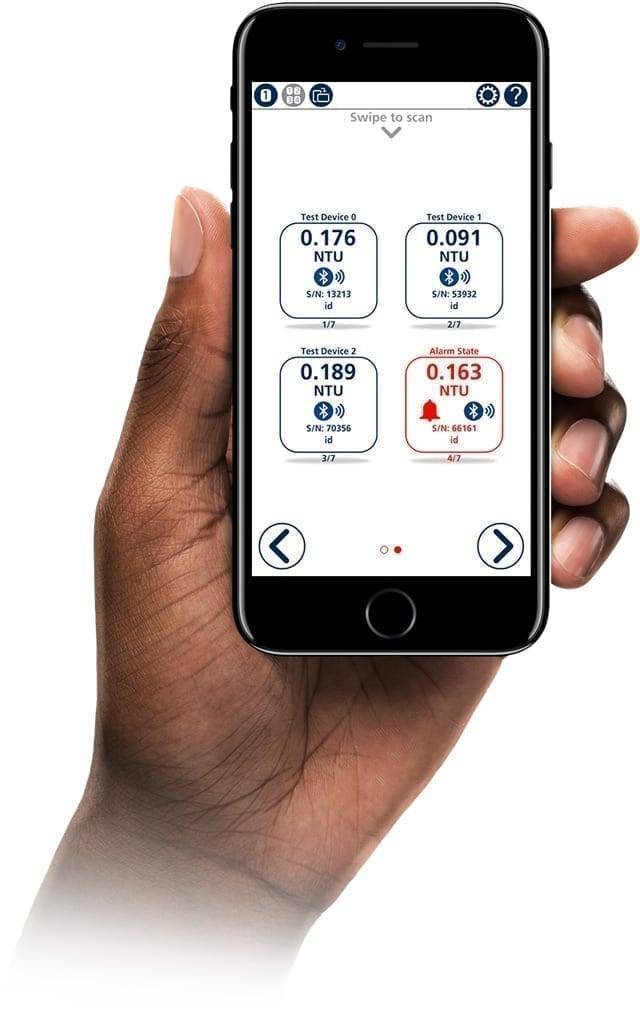
Work with the PTV 1000 on your iPhone
Lovibond AquaLXP provides a mobile interface for compatible Bluetooth-equipped PTV analysers. Check the instrument configuration and your phone’s requirements before pairing.
Review what happened
See readings and activity records, including verification, calibration, cleaning and maintenance. Graph and table views help you investigate changes and share the data for further review.
Follow the guided procedures
Use the app for supported tasks while following your site procedures. Confirm access permissions and the instrument’s Bluetooth capability before you go to site.

See how the instrument is installed and serviced
Watch Lovibond demonstrations for installation, calibration, verification and routine service.
Watch the video guidesPTV 1000 questions
What does the PTV 1000 measure?
It measures turbidity in a flowing water sample by detecting light scattered by particles. It is intended for continuous low-level monitoring in drinking-water applications.
Which optical models are available?
The infrared model uses ISO 7027 and reports in FNU. The white-light model uses the Lovibond white-light LED method and reports in NTU.
Where can I use it?
Typical points to review include filter outlets, membrane filtrate and treated water. Confirm the sample conditions and measurement objective at each point.
What happens if there is air in the sample?
Bubbles can affect an optical reading. The instrument has a bubble trap, and a stable sample arrangement still matters.
Can it connect to a plant monitoring system?
Check the exact instrument and junction-box configuration against the signals or protocol your site requires.
What should I prepare before specifying one?
Record the sampling point, optical method, expected range, sample flow and pressure, drain location and required plant connection.
Configure your PTV 1000
Choose where you’ll measure, which optical method applies and how the reading will reach your plant system. Save a brief for discussion with PMA.
Your configuration brief
- Monitoring point
- Filter outlet
- Optical model
- Confirm the optical method
- Plant connection
- Confirm plant connection
Confirm the sample conditions and exact junction box with PMA before specifying an instrument.
Planning a PTV 1000 installation?
Gather the sample, method and plant connection details for a discussion with PMA.
Prepare your enquiryStart with the sample
Have the sampling point, expected turbidity and operating flow to hand.